From Space to Place and Back Again Reflections on the Condition of Postmodernity Pdf
 Life is full of opportunities to step outside the comfort zone, only grabbing hold of them can exist difficult.
Sometimes the trouble is not being aware of reasons to do then. After all, if the feeling of condolement signifies our near bones needs are being met, why should we seek to carelessness it?
What holds people back about of the fourth dimension is their frame of heed rather than any singled-out lack of knowledge.
This article looks at the shifts in thinking required to pace outside of comfort and into personal growth. Along the way, we'll outline useful tools, tactics, and examples to help make leaving the comfort zone as rewarding every bit possible.
Before you go on, nosotros idea y'all might like to download our three Goal Accomplishment Exercises for free. These detailed, science-based exercises volition help you lot or your clients create actionable goals and main techniques to create lasting beliefs modify.
What Is the Comfort Zone in Psychology?
At present firmly embedded in cultural discourse, the metaphor of 'leaving 1's comfort zone' became popular in the 1990s. The phrase 'comfort zone' was coined by management thinker Judith Bardwick in her 1991 work Danger in the Condolement Zone:
"The comfort zone is a behavioral state within which a person operates in an anxiety-neutral condition, using a limited set of behaviors to deliver a steady level of operation, usually without a sense of risk."
Within the comfort zone, there isn't much incentive for people to reach new heights of performance. It's here that people go near routines devoid of take chances, causing their progress to plateau.
Only the concept tin can be traced further dorsum to the earth of behavioral psychology.
In 1907, Robert Yerkes and John Dodson conducted one of the commencement experiments that illuminated a link between anxiety and performance.
They saw that mice became more motivated to complete mazes when given electric shocks of increasing intensity – only just upward to a point. To a higher place a sure threshold, they began to hide rather than perform.
Respective behavior has been seen in man beings. This makes sense because in response to anxiety-provoking stimuli, the options are either fight (meet the challenge), flight (run away/hibernate), or freeze (become paralyzed).
The Yerkes–Dodson Law (Yerkes & Dodson, 1907) is truthful not just for more than tangible types of functioning, such as beingness given a stressful new job at piece of work, but too in many life areas such equally agreement ourselves, relating to others, and so on.
The cadre idea is that our nervous systems have a Goldilocks zone of arousal. Too little, and you remain in the comfort zone, where colorlessness sets in. But too much, and you enter the 'panic' zone, which likewise stalls progress:

From Comfort Zone to the Growth Zone
When leaving the condolement zone, fear doesn't always equate to existence in the panic zone. As the below diagram shows, fright tin be a necessary step en road to the learning and growth zones:
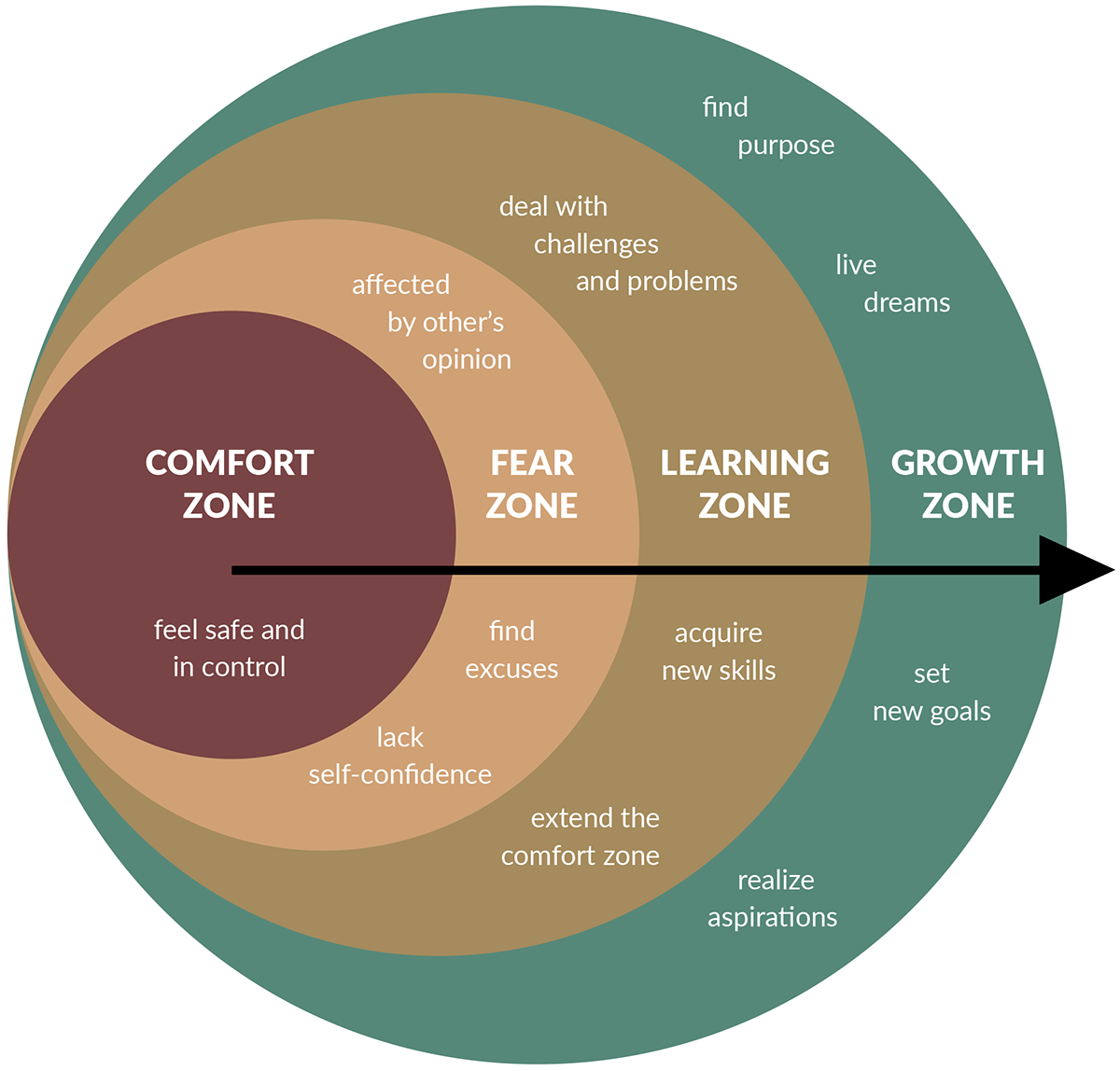
Source: PositivePsychology.com 'Leaving The Comfort Zone' Toolkit
Information technology takes courage to step from the comfort zone into the fear zone. Without a clear roadmap, there's no way to build on previous experiences. This can be anxiety provoking. However persevere long enough, and you enter the learning zone, where you proceeds new skills and deal with challenges resourcefully.
After a learning period, a new comfort zone is created, expanding ane'southward power to reach even greater heights. This is what it means to be in the growth zone.
Information technology's important to state that similar most behavioral change attempts, moving into the growth zone becomes harder without some level of self-sensation. Thus, it can be beneficial for clients to consider the following:
- How large are their zones?
Across every life domain, everyone's zones vary in size. To leave your comfort zone, you must appreciate its outer limits. Similarly, y'all must develop an intuitive sense of where your panic zone lies. Taking on challenges that lie somewhere in between will stretch you, leading to growth and learning. - What are their strengths?
Understanding and capitalizing on personal strengths tin can be of great use. Most people accept experience leaving the condolement zone in at to the lowest degree i area of life, and in that location are usually plenty of insights to be uncovered from this experience.
In reality, the process of moving from the comfort zone to a growth zone may not be linear. Peaks, troughs, and plateaus often complicate the journey. Sometimes, we fifty-fifty demand to retreat to the condolement zone periodically before mustering the strength to leave again. Nevertheless, affectionate the steps can help in tolerating doubtfulness.
While occupying the comfort zone, information technology's tempting to experience safe, in control, and that the environment is on an fifty-fifty keel. It'southward smooth sailing.
The best sailors, still, aren't built-in in smoothen waters.
Nosotros'll explore a few powerful benefits of leaving the condolement zone in the adjacent section.
Benefits of Leaving the Condolement Zone: 4 Examples
Aside from enhancing functioning, there are plenty of less-direct benefits of leaving the comfort zone. A full list would require a dissever commodity, so here are 4 top-line, broadly applicative examples.
i. Self-actualization
For many, self-actualization acts every bit a powerful incentive to exit the comfort zone. The concept was popularized through Abraham Maslow's (1943) theory of human being motivation, which he described as follows: "What a man can exist, he must be. This need we may call self-appearing."
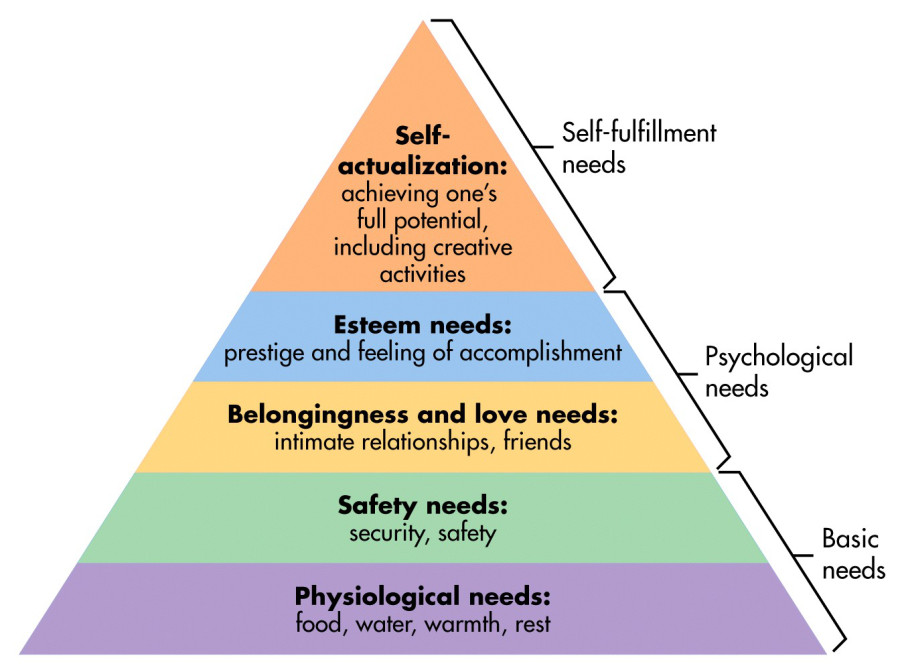
Maslow'south bureaucracy of needs operates similar a ladder, with the satisfaction of our 'basic' and 'psychological' needs being analogous to inhabiting the comfort zone. Only whether we're conscious of it or not, the theory argues our next requirement is for personal growth and fulfillment.
As long as the decision to leave the comfort zone aligns with a person'due south values, this shift is akin to making a bid for cocky-actualization. Why is this important? For 1, non striving for growth could mean falling into a state of inertia later in life.
2. Development of a growth mindset
Stanford psychologist Carol Dweck's (2008) work on mindsets marked a prototype shift in the field of positive psychology. Her research distinguished between two contrasting belief systems – the fixed versus growth mindsets.
With a stock-still mindset, people believe they have fix doses of each ability, with a respective ceiling on how much they can reach. Failure reveals inadequacy, and criticism becomes a fatal blow to self-esteem.
The growth mindset means recognizing humans as malleable. From this stance, setbacks become opportunities for learning (Dweck, 1999) and our potential becomes unlimited.
Intentionally leaving the comfort zone goes hand-in-hand with developing a growth mindset. While the fixed mindset keeps the states trapped by fear of failure, the growth mindset expands the possible. It inspires us to learn and take healthy risks, leading to positive outcomes across life domains.
3. Resilience and antifragility
Life isn't exactly a anticipated affair; perhaps then, people shouldn't be either. Sooner or later, everyone faces adversity. A habit of expanding our comfort zone equips people to handle modify and ambiguity with more than poise, leading to resilience.
Taking this further, statistician Nassim Taleb (2012) introduced the concept of 'antifragile' systems, which "thrive and abound when exposed to volatility, randomness, disorder, and stressors." Examples include evolution and immune systems, besides as the human psyche.
While resilient systems bounce back to the same level subsequently a shock, antifragile systems larn to grow from them, reaching new heights. To stride outside the comfort zone and so is to purposefully cultivate antifragility – so long equally we don't veer into the panic zone!
4. Greater self-efficacy
As outlined by Albert Bandura (1997), self-efficacy is the belief in existence able to execute necessary actions in service of a goal. Goals that pb to higher self-efficacy are specific, not too hard, and short-term (Yailagh, Lloyd, & Walsh, 2009).
Leaving the comfort zone means a phase of trial and error, during which at to the lowest degree some level of success is inevitable. Experiencing this success builds our cocky-efficacy, with belief in our ability starting to abound.
Like other benefits of leaving the comfort zone, this probably won't happen overnight. All the same the cumulative upward spiral of accomplishment and confidence can become a potent asset for anyone.
4 Tips to Support Leaving Your Comfort Zone
What follows are four useful tips to support clients in leaving their comfort zones. These are a mix of mindset tips and practical guidance on setting goals.
1. Reframe stress
Physiologically, in that location's no difference between feet and excitement (Smith, Bradley, & Lang, 2005). Both entail a 'stress response,' but whether they're perceived as positive or negative is a matter of labeling.
Society tends to conceptualize all stress as 'bad,' but the idea of 'eustress' or 'positive stress' challenges this. Eustress provides the energy to go through a public speech, go on a romantic appointment, and so on. These stimuli tin be reframed every bit exciting, propelling us out of the comfort zone.
2. Sympathize neuroplasticity
An essential step toward internalizing the growth mindset is to embrace neuroplasticity inquiry. In one case understood, less courage is needed to brand the first move abroad from comfort considering failure itself becomes integral to the journey.
At the cadre of Dweck'southward theory is that humans are malleable and adaptable. Another skillful fashion to appreciate her philosophy is past watching this TED talk:
three. Prioritize
Occupying the comfort zone isn't e'er detrimental. For example, it might exist reasonable to stay in your ukulele-playing comfort zone but non your managing-personal-finances one.
The point is to identify bottlenecks: areas of life where existence also comfortable does more than harm than good. Encourage goal selectivity in clients so they tin can focus effectively.
4. Small steps
It's okay to take minor, methodical steps, besides as larger, bolder ones. Leaving backside the condolement zone doesn't mean recklessly throwing circumspection to the wind. Every stride forrad is progress.
Patiently fostering self-sensation while intelligently assessing each zone's boundaries is a sure way to brand the process as polish equally possible.
7 Ways to Leave Your Comfort Zone
Having covered the what, why, and how of leaving your comfort zone, let'due south now embrace seven ways someone might effort to do so.
1. Do everyday things differently.
In everyday life, at that place are ample opportunities to challenge yourself. Turn off your smartphone and television while having dinner, decide what to wear more than speedily, or just slow downward to have in the surroundings on a walk. These changes interruption you out of one-time, comfortable routines.
2. Aggrandize your professional skillset.
Growing your skillset can foster creativity and refresh your self-confidence, as well as increase employability. Skills like public speaking, negotiation, and leadership can represent a new challenge for many people. Investing in them can build resilience, personal satisfaction, and open up up more opportunities than always.
3. Try a new diet.
Many people want to improve their diets and stop relying on 'comfort foods.' Doing so oft ways trying something new.
Sticking to a healthy diet can be as challenging equally it is rewarding, with cocky-efficacy growing as you striking milestone goals forth the way.
4. Take workouts to the next level.
Similarly, many aspire to this goal. For some, it tin can hateful running their first 5K, simply for others, it might be completing a triathlon.
Aiming loftier with exercise is allegorical of leaving the comfort zone and a groovy mode to go the ball rolling.
five. Become creative.
Creativity – anything from writing a verse form to building a business concern – usually involves an chemical element of take chances. Creative endeavors are about stepping into the unknown, with failing and subsequent learning every bit expected outcomes.
Exercising creativity is a good mode to train yourself to have a growth mindset and let go of a need for perfection from the outset.
vi. Challenge your behavior.
While exploring alternative perspectives tin can be uncomfortable, it enables growth and insight past challenging entrenched beliefs.
This might take several forms, such every bit reading varied book genres, diversifying who you talk to, and visiting new places. It'south easy to go stuck in our ways, but this can pb to complacency – a hallmark of being in the condolement zone.
7. Practice honesty.
When employed sensitively, honesty can be a tremendous catalyst for personal growth. Whether being straight with yourself in a individual journal or telling someone close how you feel, honesty forces people out of their comfort zone. Through honest communication, we can empathise ourselves better and build deeper bonds with others.
10 Inspiring Quotes
Hither are ten quotes that encapsulate many of the ideas discussed:
All growth starts at the terminate of your comfort zone.
Tony Robbins
You can only grow if you are willing to feel awkward and uncomfortable when y'all try something new.
Brian Tracy
My comfort zone is like a little bubble effectually me, and I've pushed it in different directions and made it bigger and bigger until these objectives that seemed totally crazy eventually autumn inside the realm of the possible.
Alex Honnold
Do i matter every day that scares you.
Eleanor Roosevelt
Becoming is better than being. The stock-still mindset does not permit people the luxury of becoming. They take to already be.
Carol Dweck
Ane tin can choose to become back toward safe or frontward toward growth. Growth must be chosen again and again; fear must be overcome again and again.
Abraham Maslow
Without continual growth and progress, such words equally improvement, achievement, and success have no meaning.
Benjamin Franklin
Yous have calibrated life when most of what y'all fright has the titillating prospect of adventure.
Nassim Taleb
The level of effort yous tolerate from yourself will ascertain your life.
Tom Bilyeu
May your choices reflect your hopes, not your fears.
Nelson Mandela
PositivePsychology.com's Useful Tools
PositivePsychology.com is an splendid repository of tools you lot can leverage in supporting clients to go out their condolement zones behind.
Our Toolkit offers various worksheets and exercises designed to help people enter the growth zone and realize their potential.
Here are three examples:
- Facing the Issue of Fear-Based Beliefs on Goal Accomplishment
This tool introduces clients to the bear on of fear-based beliefs on goals and personal growth. Exercises challenge them to analyze how their anxieties stop them from pursuing goals that would be meaningful to them. - Leaving the Comfort Zone
This tool helps clients weigh the costs of staying in the comfort zone. The four zones are explored in more detail, with questions to prompt clients to utilize the knowledge to their own lives. Ultimately, the goal is to trigger a positive upwardly spiral of personal fulfillment. - Moving Toward a Growth Mindset
This intervention moves people toward the growth mindset past correcting fixed mindset thoughts. The exercise encourages agile reflection, with a useful 'mindset log' worksheet.
An boosted resource that may seem baroque yet revealing is titled My Gravestone. For any client reluctant to depart from a comfortable routine, reflecting on their future tombstone could exist a remarkable incentive to footstep into a growth mindset.
17 Motivation & Goal-Accomplishment Exercises – If you're looking for more science-based ways to assist others reach their goals, this collection contains 17 validated motivation & goals-achievement tools for practitioners. Use them to help others turn their dreams into reality by applying the latest scientific discipline-based behavioral change techniques.
A Take-Home Message
Recognizing opportunities to go out the comfort zone isn't always easy; neither is seizing them with conviction.
It's crucial to cultivate a mindset that lays strong foundations, paving the way toward the growth zone. This includes seeing yourself equally inherently adaptable, reframing stress, and believing in your ability to endure fears and doubts.
Every person faces this choice, knowingly or non. You lot can settle for what you lot know – the seemingly safe, familiar, and routine. Or, you lot can become receptive to opportunities for growth, challenging your personal status quo and seeing what you're capable of.
When this becomes a addiction, the benefits to exist reaped throughout life are copious. Non only are disappointments curbed and regrets avoided, but we also reach our highest human being potential, interim as an inspiration to others.
Nosotros hope you enjoyed reading this article. Don't forget to download our three Goal Achievement Exercises for free.
- Bandura, A. (1997). Self-efficacy: The practice of control. New York, NY: West. H. Freeman and Company.
- Bardwick, J. (1991). Danger in the comfort zone: From boardroom to mailroom – How to interruption the entitlement habit that's killing American business. American Management Association.
- Dweck, C. Southward. (1999). Self-theories: Their role in motivation, personality, and development. Philadelphia, PA: Psychology Press.
- Dweck, C. S. (2008). Mindset: The new psychology of success. New York, NY: Ballantine Books.
- Maslow, A. H. (1943). A theory of human motivation, Psychological Review, 50, 370–396.
- Smith, J. C., Bradley, Chiliad. M., & Lang, P. J. (2005). State feet and affective physiology: Effects of sustained exposure to melancholia pictures. Biological Psychology, 69, 247–260.
- Taleb, N. N. (2012). Antifragile: Things that gain from disorder. New York, NY: Random House.
- Yailagh, Grand. S., Lloyd, J., & Walsh, J. (2009). The causal relationships between attribution styles, mathematics self-efficacy beliefs, gender differences, goal setting, and mathematics accomplishment of schoolhouse children. Journal of Education & Psychology, iii, 95–114.
- Yerkes, R., & Dodson, J. (1907). The dancing mouse, A study in animal behavior, Periodical of Comparative Neurology & Psychology, 18, 459–482.
Source: https://positivepsychology.com/comfort-zone/
0 Response to "From Space to Place and Back Again Reflections on the Condition of Postmodernity Pdf"
Post a Comment